
“What does a lacquer door cost?” is the first question in every trade conversation — and the honest answer is: it depends on five variables you can control. Understanding them lets you spec a kitchen that hits budget without giving up the look.
1. Profile complexity
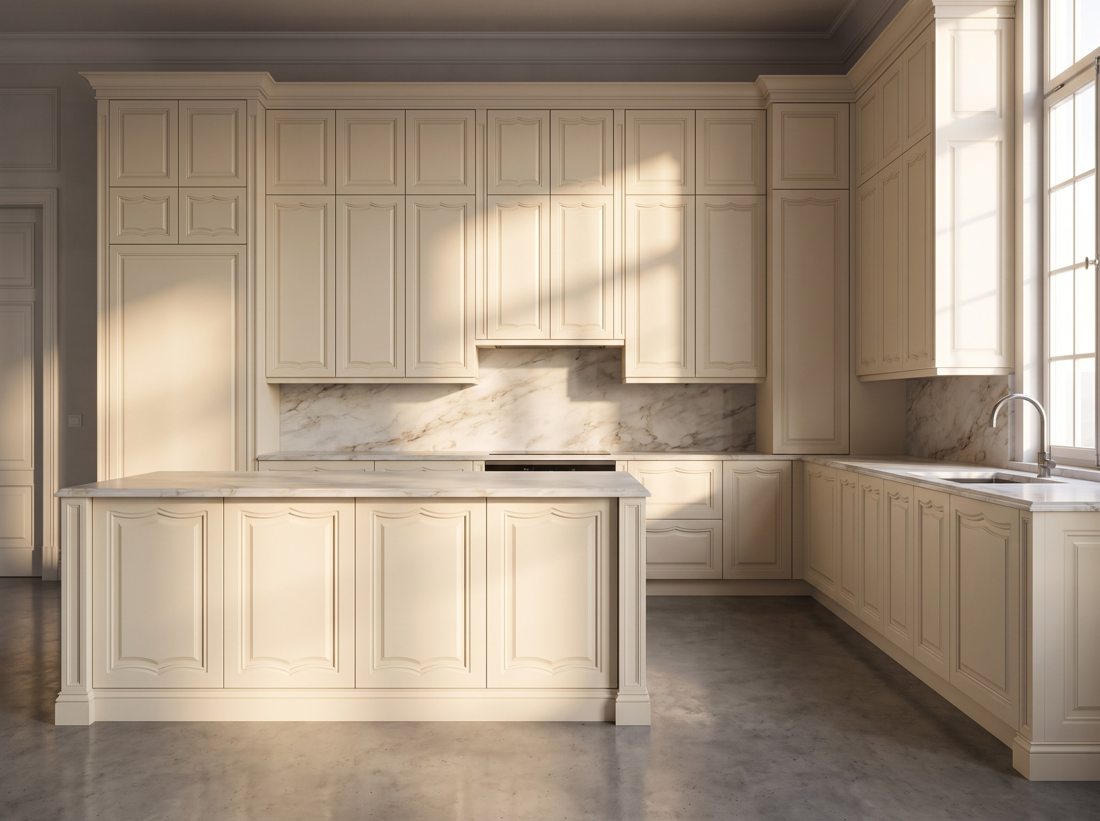
A smooth slab is the baseline. Applied framing, raised panels and sculpted profiles add CNC time and sanding labour; fluted and reeded faces add more. As a rule of thumb, a classic framed profile runs 15–25% over slab, a deep sculpted profile 30–45%.
2. Sheen
Matte and satin are the workhorses. High gloss demands additional coats, polishing and a dust-controlled booth, which is why HG doors carry a premium — reserve them for feature runs and handle the rest of the room in matte of the same colour.
3. Colour
Standard palette colours cost nothing extra. Custom RAL matching adds a small mixing fee per order — not per door — so a whole kitchen in a custom colour is barely different from a stock one.
4. Glass frames
A glass-front frame replaces the panel with a routed opening and adds hardware prep. Priced per piece, they typically land near the cost of the equivalent solid door — the glass itself is usually supplied locally by the installer.
5. Volume
This is where trade buyers win. Door production is setup-heavy: one kitchen of 30 doors in one colour sprays far more efficiently than 30 singles. Our program uses volume tiers — the per-door number steps down at realistic project quantities, and multi-project contractors can pool monthly volume.
Getting a real number
Generic price-per-square-foot tables are guesses. A door schedule — even a rough one with counts and sizes — gets you an accurate quote the same week. Send your scope here, or flip through the catalog and reference model names directly.