
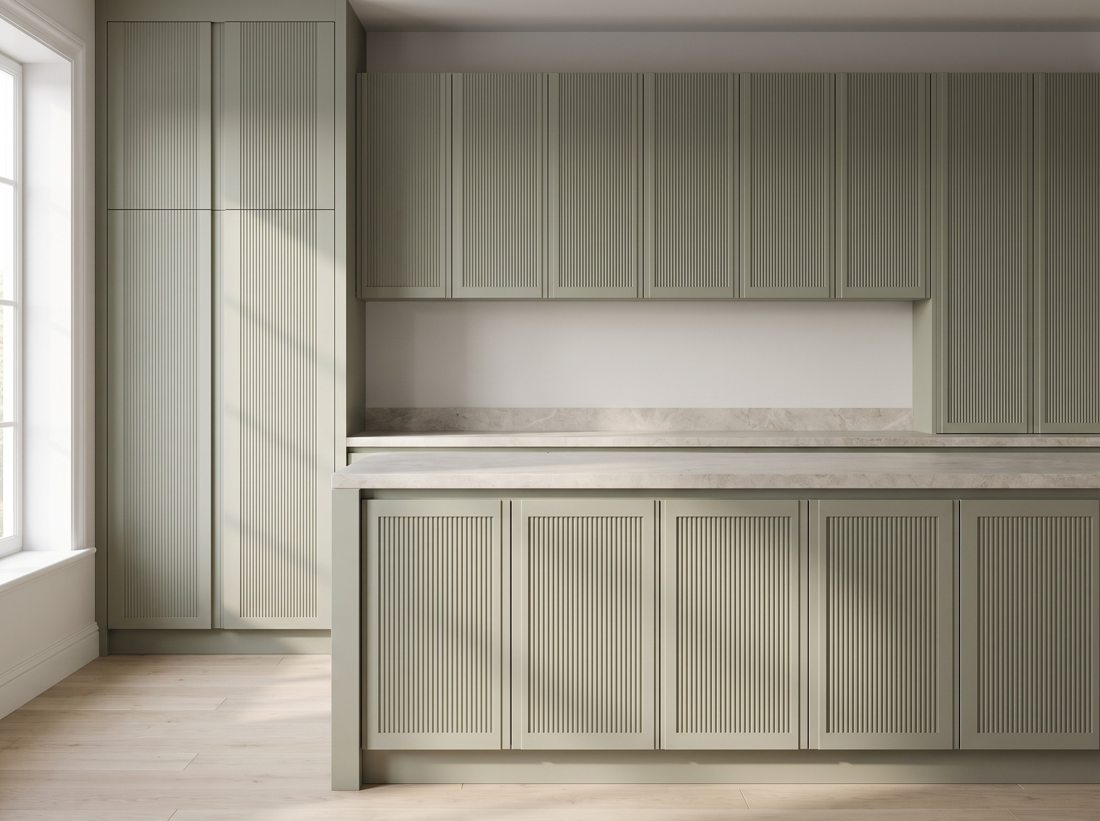
Flat kitchens photograph well; textured kitchens sell. The vertical rhythm of fluted and reeded door faces catches raking light and gives even a single-colour kitchen depth that clients respond to instantly — which is why texture keeps topping designer trend lists.
Fluted, reeded, grooved — what's the difference?
Fluted faces carry rounded concave channels; reeded is the convex opposite, like a run of dowels; V-groove and pinstripe faces use fine angular lines for a subtler effect. In lacquer, all three machine cleanly into MDF and spray to a uniform, easy-clean surface — no wrapped foil seams inside the channels.
Where texture works hardest
Use texture where light moves across it: island fronts, tall wardrobe runs, hood surrounds and bar backs. Pair a textured island with smooth perimeter doors in the same colour — it reads as custom design, not catalogue furniture. Under-cabinet and in-cabinet lighting doubles the effect after dark.
Colour choices that flatter texture
Mid-tone colours show the shadow play best: sage, olive, clay, mineral blue-greys. Very dark colours flatten the channels in dim rooms; very pale colours whisper. Our Multi Country collection has 22 textured designs — Aspen, Snowdrop, Tigris, Harbor and friends — each shown as a full set and lacquered to any RAL colour.
Speccing notes for the trade
Order textured fronts with matched plain interiors to control cost; keep channel direction consistent across adjacent fronts; and on handleless projects, pair with push-latch or J-channel — the texture hides the channel beautifully.